.jpg)
How to keep going when life roads are foggy?
Speedy windstorms that go through sea cliffs, deep blue waters that invite seabirds for a drop, endless rolling moors that hide small villages in the hugging hills – these are the landscapes of the far north of Scotland where the whole Cormack’s family tree rooted to. But he was born where grasslands, palms and jacaranda trees make the most natural scenery, in Johannesburg, South Africa.
His great-grandfathers were mainly involved in fishing industry, his father was a telecommunications specialist curious about mechanical and electrical gadgets, his mother was a teacher and a painter, and he, interested in astronomy and theatre, became a physicist and got his Nobel Prize in the field of Physiology or Medicine.
It is easy to think that Allan MacLeod Cormack spent long time being not at his place or doing not what he was meant to do, but each his experience added to his formation as a personality and as a professional, even though life did sometimes look unstable or illogical.
Learn from surroundings
Allan’s parents moved to South Africa when it was still a part of the British Empire. In early 1900s, nobody could think that in about 30 years many territories we know today as independent counties (including Canada, Australia, New Zealand, and South Africa) would actually get their autonomy from the United Kingdom. By Allan’s 14th birthday, the family had left Johannesburg to Cape Town, and Allan was enrolled to a government school. As many government schools, the Rondebosch Boys’ High School had its own principles and standards while the majority of teachers prioritised their students’ wellbeing and skills development. Think about the following approaches and outcomes Allan would witness on a daily basis:
- Allan’s maths teacher was also keen at swimming and athletics which would definitely make it a clear for the teenager that one does not have to limit themselves with one field only as long as they are persistent enough in their interests. Later, during his undergraduate studies, Allan would seriously go in for climbing and even completed a new route, always referred to as Cormack’s route by his friends (the registered name was Procrastination Crag).
- Black children were officially denied from the school, so a former headteacher of the Rondebosch School established another school for these students – apart from its direct impact, the example of real-life meaningful care left lasting impression on white students, including Allan.
- The school teacher of physics was so dedicated to his subject that the laboratory he created in the school became known to teachers from other districts. He was one of the teachers adopting demonstrations of physical phenomena in the classroom, and for young Allan that became a true inspiration for further professional development.
Follow your dreams
One of the dreams Allan had as a teenager was to become an astronomer. Taking a realistic approach, Allan was sure his school was not enough to secure him a place for advanced studies despite his genuine interest and excellent school results in mathematics.
- He came back to the dream in his 20s – Allan immersed himself in astronomy during a two-months vacation he had between the Bachelor and Master studies. He provided new measurements of brightness of the stars, the data appeared extremely accurate and ultimately made Allan’s first academic publication.
Interestingly, Allan’s second big dream was strongly related to the first one. Thinking about the career of astronomer, Allan believed that Cambridge University was a key factor to succeed in the field. He could only confirm the assumption when discovering all his professional co-workers in the observatory in Pretoria (another big city in South Africa) were Cambridge graduates.
- Cherishing this part of his dream, Allan did his best to find a way to one of the top universities in the UK. A couple of years after the Master studies, Allan was awarded the fellowship for overseas studies from the University of Cape Town and the Department of Physics at the University of Cambridge accepted him as a research (doctoral) student.
Embrace opportunities
At his 15, Allan happened to be appointed as a Junior Librarian at the school library, and he used this time as a perfect opportunity to learn about modern science.
From there, he learnt that Albert Einstein had already presented his relativity theory, Ernest Rutherford and Niels Bohr had shared their ideas on atomic structure, Lawrence Bragg who had been working on the composition of X-rays had become the youngest scientist to be awarded the Nobel Prize. Hence, the world of science began to look as the most agile, inspirational and promising field.
- Allan entered the University of Cape Town in 1942, aiming to study electrical engineering. Because of the World War II, some students were called for military service, but Allan avoided the enlistment due to being too young. Meanwhile, the War uncovered the lack of physics specialists who could work with magnetic mines and radars, and the University offered a new option for electrical engineering students – to substitute some of their regular courses with advanced physics and mathematics studies.
Allan accepted the offer, and in two years, he would completely switch to physics and even enrol to a course in chemistry. - A call for interdisciplinary research in Geology and Engineering? Let’s do it!
Allan made both physics and geology parts of his thesis. - By the time he was approaching his master’s thesis, Allan had discovered crystallography for himself and was eager to focus on it for the paper. He decided to address geology once again, and provided with mineral samples, studied them with (then) a new tool, an X-ray camera.
More than 30 years later, his further work on X-ray computed tomography – a routine procedure for today’s medical workers – would bring Allan Cormack the Nobel Prize.
Remember the beginning
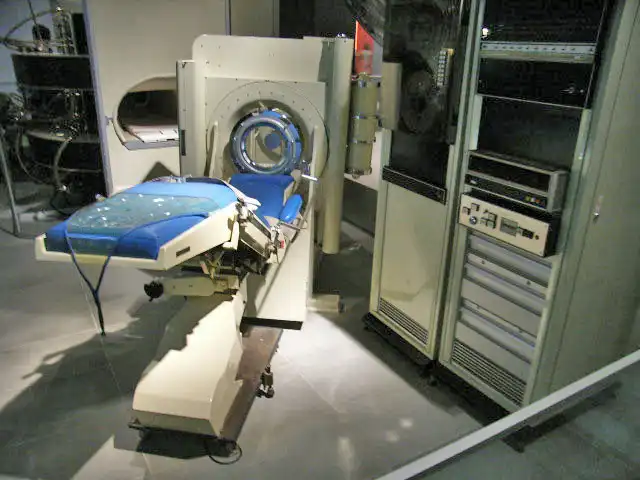
Together with his wife, Allan MacLeod Cormack moved to Massachusetts in 1957 (he was 33 at the moment). In 1963-64, he published a couple of papers with theoretical calculations he thought might be useful to build a scanner for a human body. In eight years, a team of British engineers led by Godfrey Hounsfield built the first such scanner, a computer tomographer, grounding on the calculations by Allan Cormack.
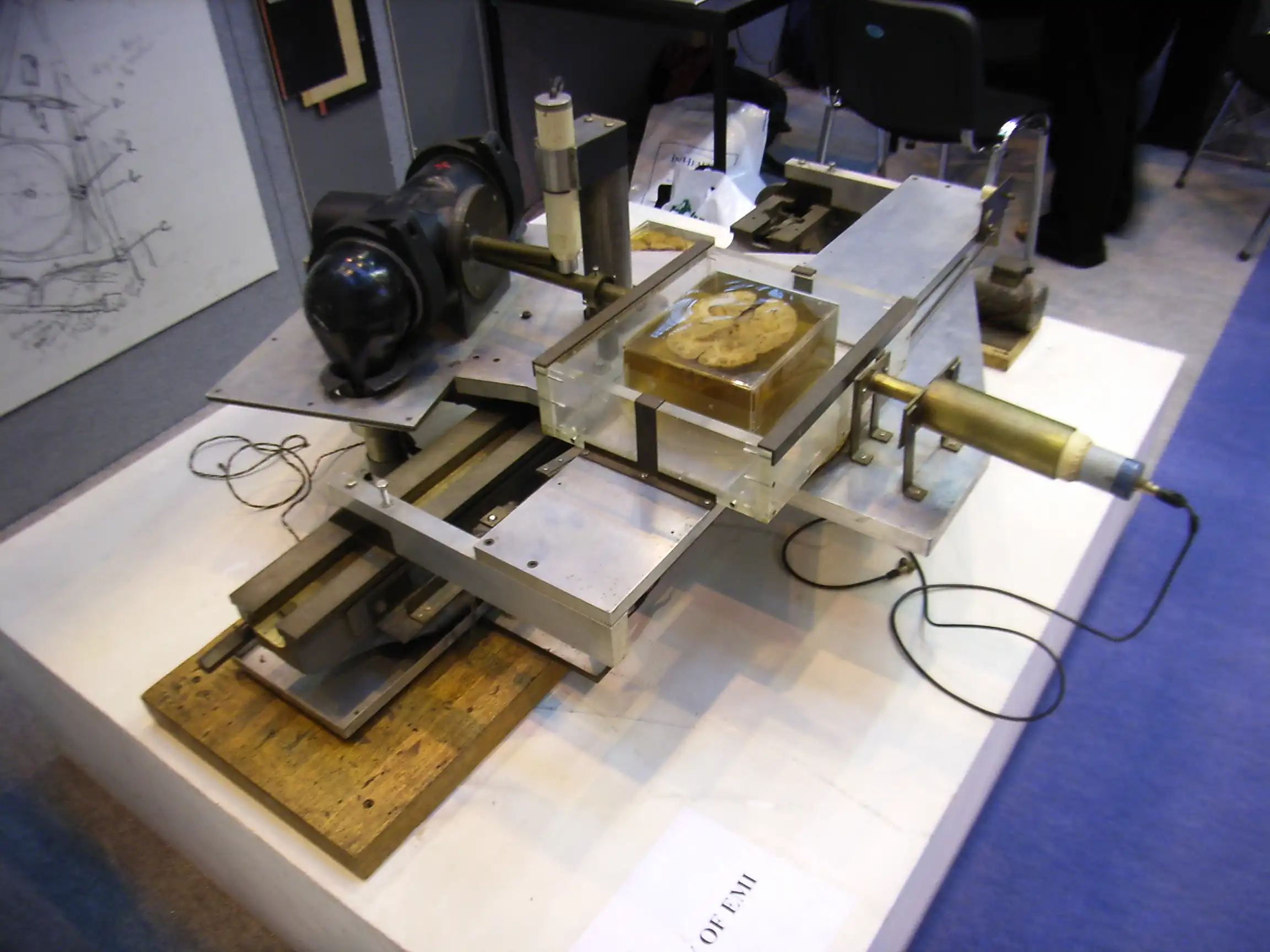
(1) The very first CT scanner prototype invented by G.Hounsfield at EMI. ©Image from Wikimedia Commons, no author provided, Gdh~commonswiki assumed (based on copyright claims), CC BY-SA 3.0;
(2) The first-generation CT scanner. Image: Public Domain, Wikimedia Commons


When in 1979 the scientists shared the Nobel Prize, Allan contacted the Rondebosch Boys’ High School with a thankful note to his maths and physics teachers, modestly saying that "…the only mathematics used was an elementary theorem on Euclid which I first learnt from either Mr Jayes or Mr Jackman!"
The materials are based on the Imagining the Elephant, a biography of Allan MacLeod Cormack, published in 2008 by Kit Vaughan, emeritus professor of biomedical engineering at the University of Cape Town.