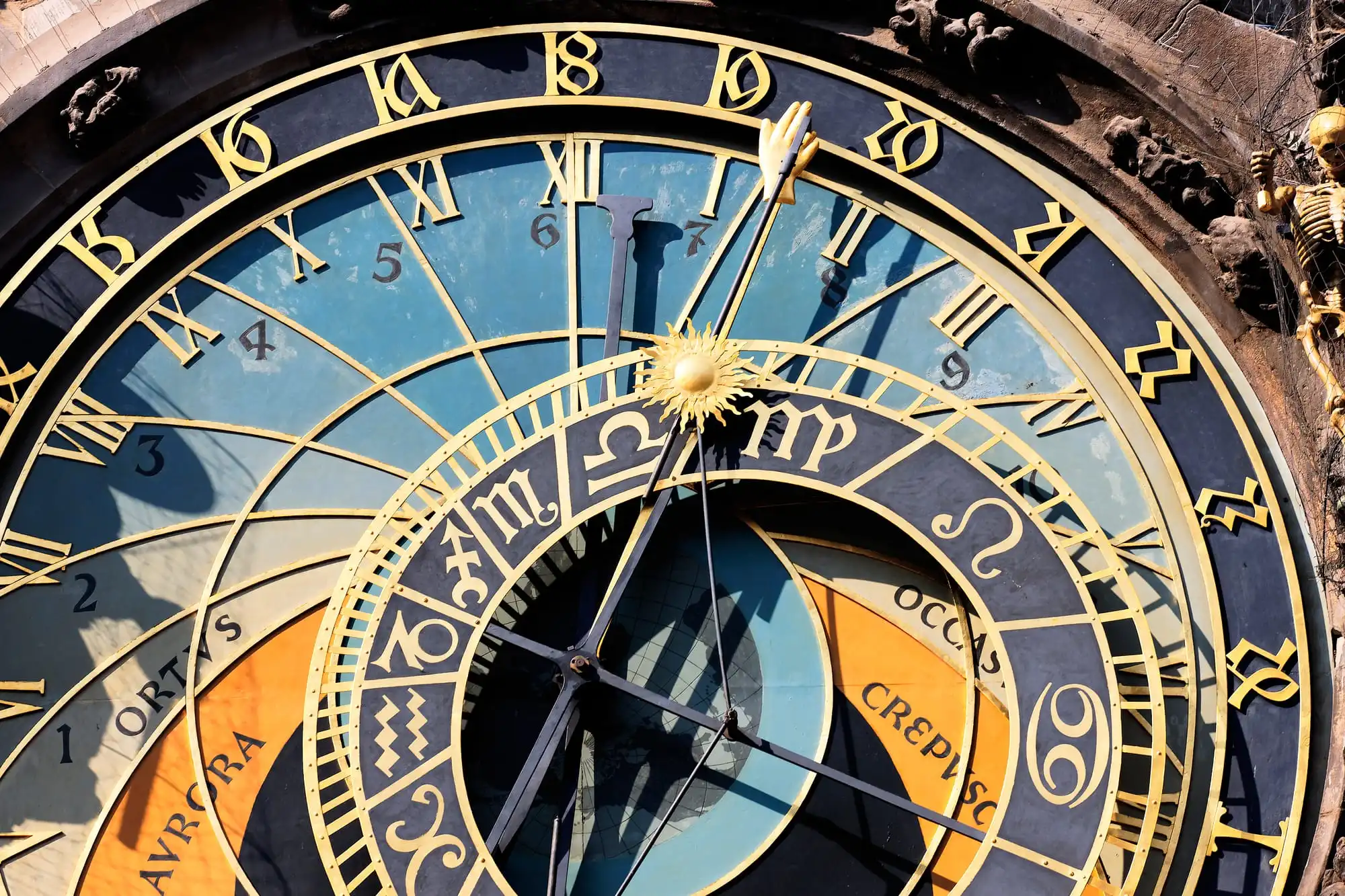
Which time is correct and whom to thank for the clock tricks you play twice a year?
Yes, we are referring to the daylight saving time (DST) or summer time, used by 70 countries in 2025. All in all, 143 countries have tried it al least once, though as you can see, many have rejected the concept. Different sources credit with the idea two Englishmen – an entomologist[=EX1] and a builder – even though the whole story had started centuries before they lived, involved more people, and brought several reasons to adjust clock hands by season.
Ancient World and Middle Ages
8th-4th centuries B.C., Ancient Rome
– Let’s have the highest point of the sun to define when an action happens. We call the moment when the sun reaches the highest position above the horizon noon , so other time periods during a solar day should be defined as before noon (ante meridiem, a.m.) or after noon (post meridiem, p.m.).
- night – before noon – noon – after noon – night
3rd century B.C. - 14th century A.D., Ancient Rome
– It appears Greeks have an advanced system of timekeeping. They also use the sun but divide the daytime into twelve periods. They call each an hour.
– So how long is an hour?
– It depends on a season and your location. For instance, at our latitude (Mediterranean), an hour is short in winter and becomes 1.5 longer in summer.
One hour would then last from 45 to 75 minutes for the Romans. For societal purposes, they would divide a day into 16 periods and use them to schedule activities and mark important events like childbirth. Naturally, the length of each period would also depend on seasonal daylight.
- midnight – the middle of the night – cock crowing – cock stops crowing – dawn – morning – forenoon – midday – afternoon – sunset – evening – twilight – lighting of candles – bed-time – far into the night – approaching midnight
As you can see, candles are some of the oldest inventions which used to be an important element of daily life. And it were candles which made people to reconsider the system of timekeeping.
14th-18th centuries, Italy
– You known, Babylonians managed to divide the day into 60 equal parts and have been following this system for centuries now. Could this approach be a better one than our floating hours which we need to adjust almost constantly?
– Let’s try. But let’s divide the day into 24 equal hours, so that each hour would also have 60 equal parts. And let’s start counting from sunset.
– Why?!
– "This way the 24th hour of a day should always end with the sunset, so we will easily know how many hours we still have before there’s a need for candles.
– Sounds interesting...
16th century, Poland, modern-day Czech Republic and parts of Germany
– Do you know the new time system Italians have adopted?"
– Yeah, but I’ve heard them criticising the 24-hours approach for not always being practical. They’re going to make it a twice-twelve system, I believe.
– They have six-hour clocks and make it four cycles of six hours a day. As for us, let’s adopt equal hours and start counting after the sunset. What about two cycles of 12 hours?
– Agreed.
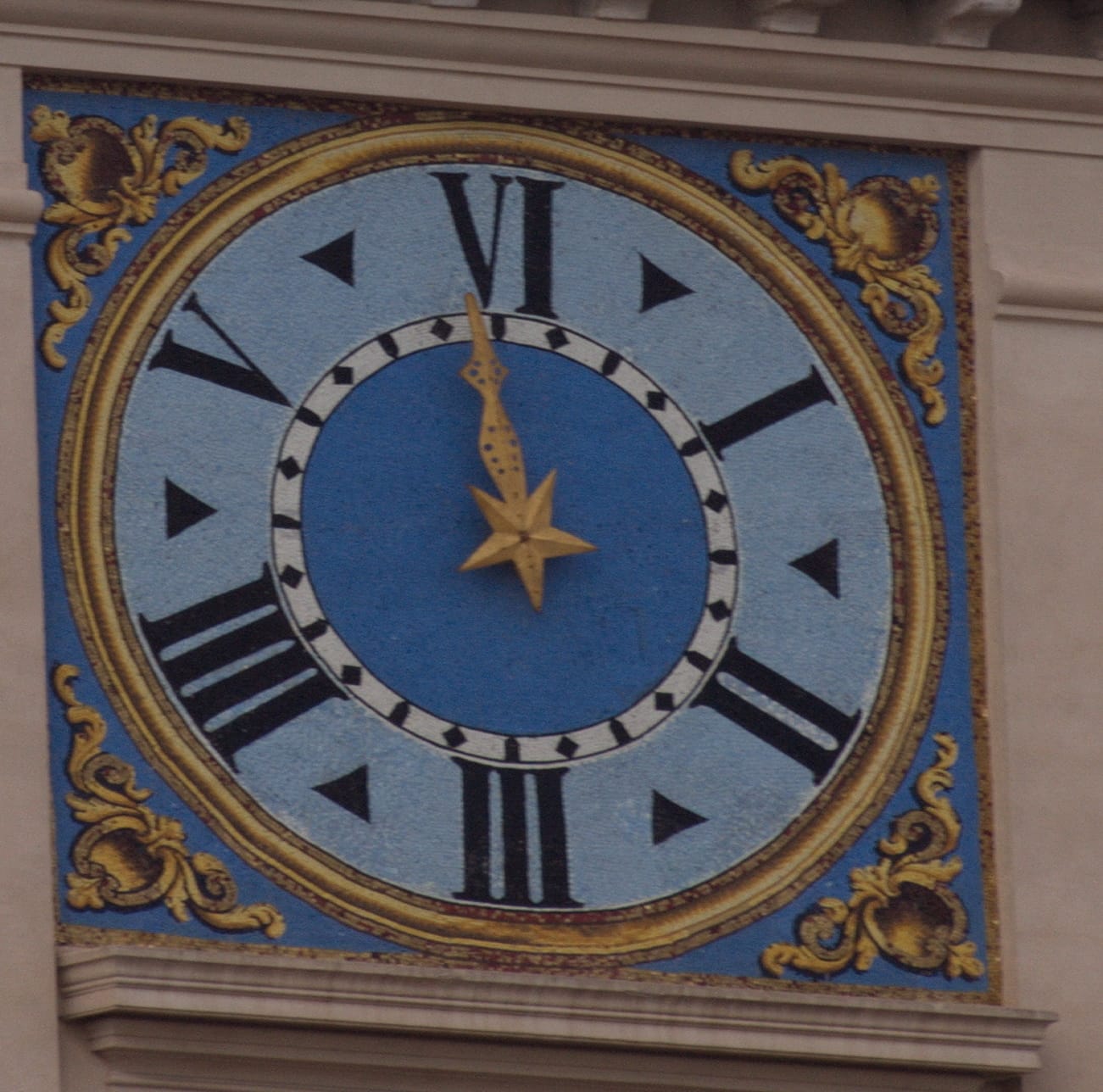
Six-hour clock at the Quirinal Palace in Rome. ©Image by Pere Garcia - Own work, CC BY-SA 4.0, Wikimedia Commons
Modern History
During the 18th century, European countries did not have a unified system of time measurement. They differed in when to start counting (sunset, sunrise, midday, or midnight?), whether to make day sections equal (though the majority had already been used to equal hours by that time), and how many parts should a day and an hour have.
A known French mathematician suggested a decimal system to measure both weight and time to simplify calculations. This was the idea of Jean le Rond d'Alembert , and it reached the second round of discussions in 34 years, when a French attorney Claude Boniface Collignon proposed to divide a day into 10 hours, an hour into 100 minutes, a minute into 1000 seconds. Another five years after that, Jean-Charles de Borda, a French mathematician who was absolutely upset with the inconvenience and mess the time-related calculations had brought would finally introduce the decimal time system where 1 day = 10 hours, 1 hour = 100 minutes, 1 minute = 100 seconds.
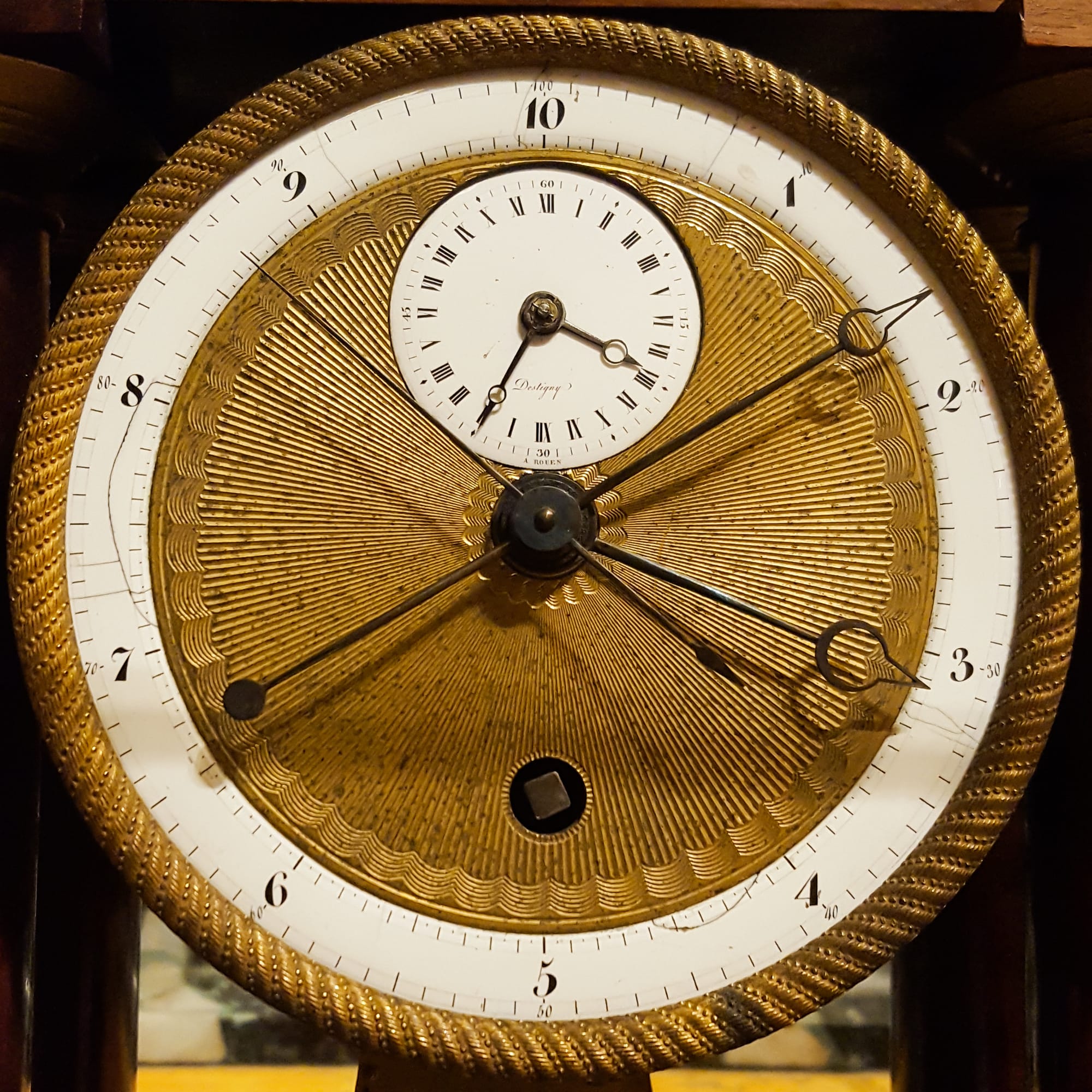
French decimal clock from the time of the French Revolution. ©Image by DeFacto - Own work, CC BY-SA 4.0, Wikimedia Commons
1784, France
An anonymous letter appears in the French daily newspaper Journal de Paris. The writer encourages Parisians to rise earlier in the morning to be able to use natural sunlight and spend less candles. To make the process even more effective, the author also suggested ringing church bells and firing cannons at sunrise.
The letter was satirical and the author was Benjamin Franklin , then a 78-year-old American diplomat who had left the position of the United States Minister to Sweden and did not know he would be elected as the sixth governor of Pennsylvania.
1810, Spain
The authorities of Cádiz adjusted their meeting times for the summer and allowed private businesses to shift their opening hours depending on a season and regular daylight conditions.
1895-1927, New Zealand
An Englishman who had moved to New Zealand as a child was then 28 years old. He worked at a post office and spent afterwork hours on his hobby – a designer and an artist, he was fond of collecting insects. His hobby made George Hudson dependent on daylight. It did not take long to notice that if he started work earlier in the morning, despite it’s dark, his shift would end when there’s still daylight. The more George thought about it, the more benefits he found, even though he objectively saw inconveniences like altering all the clocks and making people get used to the scheme.
Hudson’s idea of a 2-hours-shift reached great interest from city of Christchurch, so in a few years he presented it in the capital. After rather long discussions, New Zealand adopted DST in 1927, which was 11 years later than Australia and the United Kingdom (all being parts of the British Empire). George Hudson was already 60 at the moment.
As for collecting insects, he nevertheless managed to create the largest private collection in New Zealand. The collection includes several thousand objects and is available at the Museum of New Zealand in Wellington.
1907, England
William Willett, another Englishman who was living in the southern suburbs of London, was on his morning horse riding when he noticed many people were still sleeping and thus losing daylight hours. He knew nothing about his "New Zealand’s colleague’s" efforts concerning the issue and published his own essay. At explaining the problem, William presented a solution: let’s shift the clocks gradually, by 20 minutes during four Sundays. This way, it would be possible to get 80 "extra" daylight minutes and save about £2.5 million in lighting costs, according to Willett’s calculations.
He got support from one member of parliament (Sir Robert Pearce) and the newly appointed President of the Board of Trade, Winstone Churchill (33 y.o.) who was at the start of his political career. The idea was reviewed several times but never became a law.
A side note (1): Willett is said to have had golf as his another hobby, and it, of course, was a pity to cut the game at dusk knowing there were almost two hours missed in the morning.
A side note (2): Chris Martin, the leader of the British rock band Coldplay is one of Willett’s great-great-grandsons.
1908, Canada
The municipality of Thunder Bay (then Port Arthur) in Ontario became the first region in the world to actually introduce DST as we know it today. There were no scandals, no lobbying, but local citizens decided to try the concept. Six years later, the city of Regina in Saskatchewan joined Thunder Bay, and in another two years the cities of Winnipeg and Brandon in Manitoba also adjusted their clocks for one hour – a week earlier than European countries.
1916, Europe
Modern-day Germany, Austria, Hungary, the UK, Italy, France, Belgium, the Netherlands, Denmark, Norway, Sweden, Czech Republic, Slovakia, and Poland adopted DST as a law within few weeks. The fast-track was reasoned by the First World War being on for two years by that time. The countries aimed to save on artificial lighting as well as on coal. Coal was the main fuel and the front-line necessities should have been prioritised at the moment.
When the war ended, many countries returned to their standard time – until 1940s, for it being wartime again (then the concept of double DST was introduced in some countries), and again until 1970s, for the energy crisis in Europe.
Time is relative; its only worth depends upon what we do as it is passing.
Albert Einstein
More about time
Live time to decimal time converter – time is simply about maths😉
On Seasonal Time – text of the speech by George Hudson which he presented in Wellington to argue for the DST implementation (sourced from the Royal Society of New Zealand)
A Chronicle of Timekeeping – a historical overview of evolution of time measurement, by William J. H. Andrewes
[=EX1] a person who studies insects