What was cultural diplomacy like 100 years ago?
From a spontaneous idea to international recognition...
It's January 1, 1919, a poetry evening of one of the country-known writers. One of the listeners is the leader of the state, also a former journalist. The state he leads used to be supported by the countries which appeared defeated after the World War, and is now at risk of revolutionary hostilities caused by another political movement. The state urgently needs a survival plan.
Step-by-step, note-by-note
Music written by prominent national composers made part of the evening and by changing one mind, it changed the following 100 years. Amazed by the works he heard, the state leader started to view it as a powerful instrument.
In a couple of weeks, a chorus to represent the state internationally was created and supported by a special legislative act.
In a month, when the chorus was actively practicing their performance, they had to be evacuated because of a military invasion. Only 30 out of 78 singers agreed. New members were then accepted from other cities. The conductor of the chorus was frustrated but did not want to give up the idea.
In three months, the chorus gave their first two concerts in Galicia. The audience praised the musicians, threw them with flowers, invited to banquettes, and generally supported the idea of demonstrating authentic culture of the state to foreigners.
In four months, all members of the delegation were arrested at arrival to Czechoslovakia. The reason for that was local informers claiming that the capella represented an unwelcomed political force. The claims were disinformation but nobody checked.
When allowed to move on and met in the capital, the capella was detained for the second time – now as suspected in being part of a political force and travelling with counterfeit (illegal) money. Police officers confiscated all money the musicians had with them. The locals didn’t trust the group and viewed them as separatists whose words were false, made up, deceptive, specious, double-faced…
In four and a half months, the chorus gave their first concert in Prague. The audience heard the Carol of the Bells for the first time. It had nothing to do with Christmas yet and was titled with a Ukrainian word "Shchedryk" (Ukr. "Щедрик") meaning either a bird, or a type of spring songs used as a brief wish for a coming year to be generous. The text was written in Ukrainian, Ukrainians were the composer Mykola Leontovych (would be killed by a Soviet state security agent in less than two years), the conductor Oleksandr Koshyts (Koshetz) and every member of the chorus.
The audience was impressed. Newspapers could do nothing but publish positive reviews of the concert. Shchedryk helped the local authorities to discover the whole country and its culture. And it appeared very different from what they previously imagined or compared to.

The European serin, called "shchedryk" in Ukrainian. Image from Wikimedia Commons, CC BY-SA 3.0
During the following six months, the Ukrainian National Chorus presented their concerts in Wien, Baden (Austria), Zurich, Lausanne, Geneve, Basel, Bern (Switzerland), Paris (France), Brussels (Belgium), and for all of them the absolute favourite of the programme was Shchedryk.
In almost three years, October 5, 1922, Shchedryk became part of the concert programme by the Ukrainian National Chorus in Carnegie Hall , New York.
A standing applause from the public which during the recent years had been astonished by films and music by …Charles Chaplin.
In 17 years, Peter J. Wilhousky, an American composer adapted the Ukrainian text of Shchedryk for an American school choir. For his students, it was hard to pronounce Ukrainian words, neither could they understand the original meaning of the song, so the composer changed the text inventing the "bells theme" as central.
Carol of the Bells was recorded for a radio studio and gained the hearts.
In 100 years, Carol of the Bells is actively used in American TV industry, including animated sitcoms (The Simpsons, South Park), night show (Saturday Night Live), TV series (The Mentalist, Dexter) and films (The French Connection, Battle of the Bulbs, Home Alone, Home Alone 2: Lost in New York, and others).
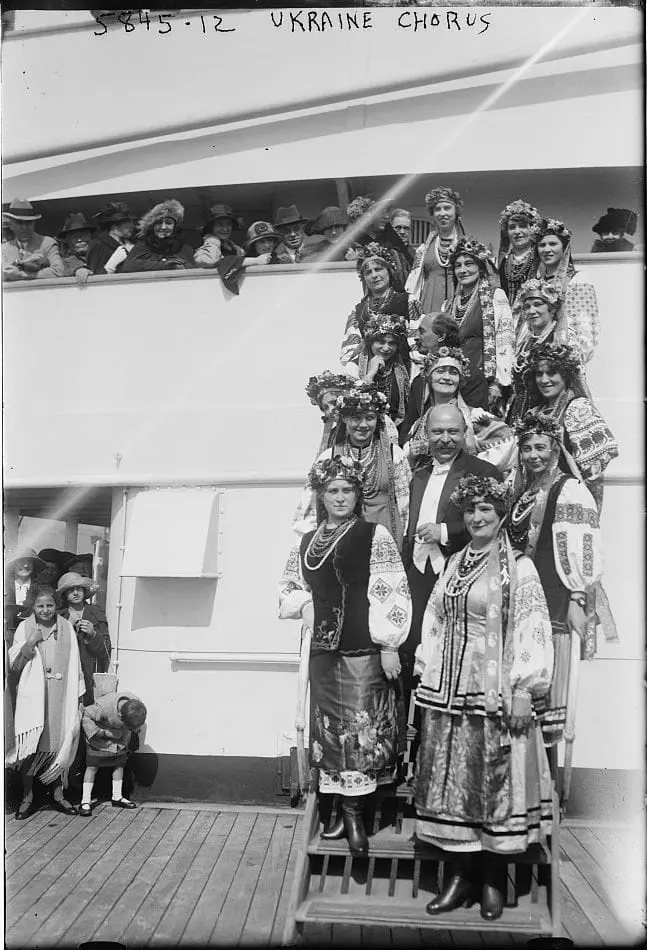
The Ukrainian National Chorus with the conductor Oleksander Koshyts (1922), by Bain News Service, Public Domain, Wikimedia Commons
Aims and results of the campaign
The terms cultural diplomacy and soft power didn’t exist 100 years ago but the phenomenon, as it comes out, did.
The short-term aim of the campaign included an attempt to influence the decisions made at the Paris Peace Conference where the future of the Ukrainian state depended on the document which would be signed. The "cultural delegation" did not manage to impact the negotiations – due to the reasons we do not cover in this article – the chapel was late to the moment of decision-making, so nothing could be changed by then.
Nevertheless, the cultural diplomacy act based on music allowed foreign authorities and common citizens to recognise the whole nation and their culture, no matter what local propaganda was saying. It ultimately appeared more long-lasting than anyone could imagine at those times.
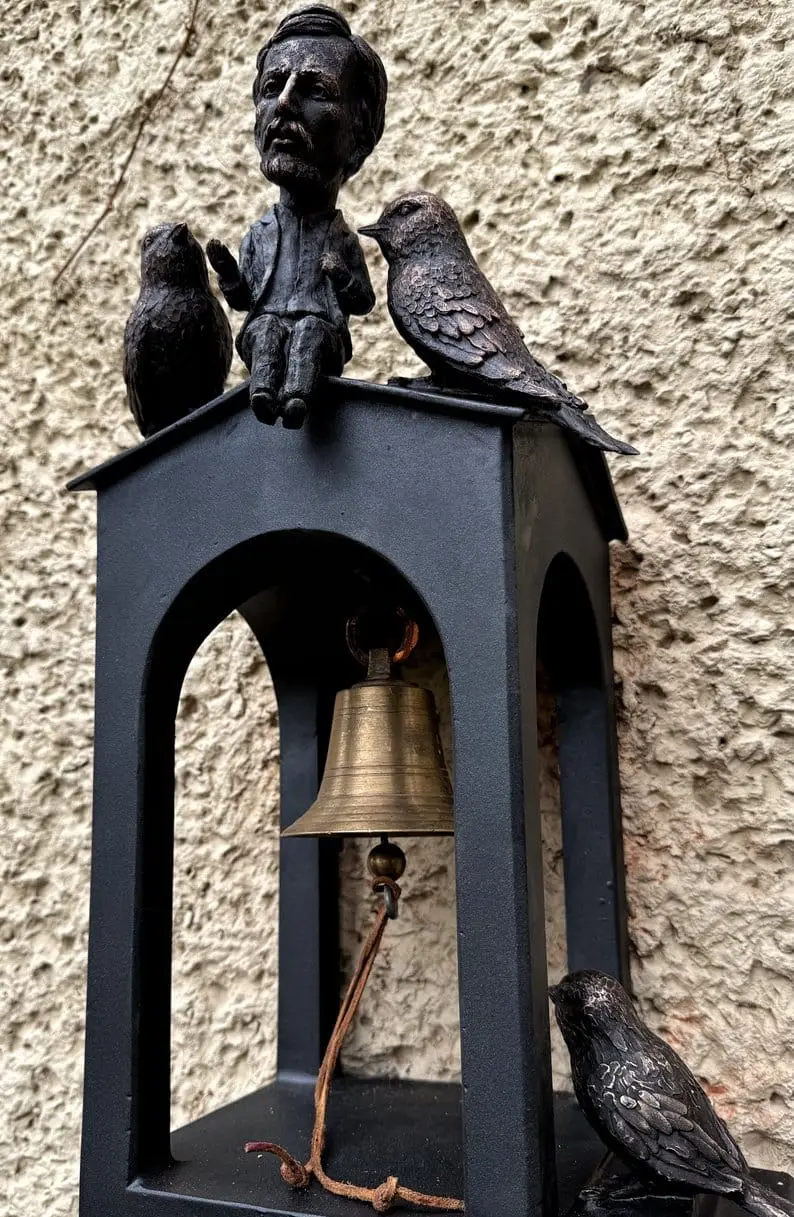
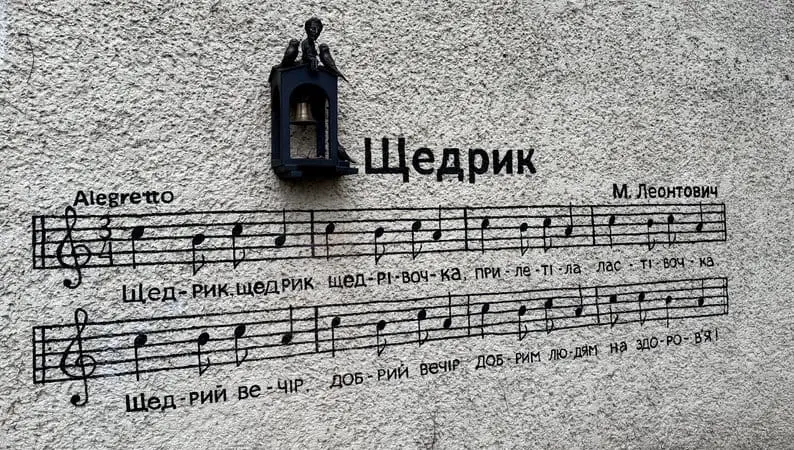
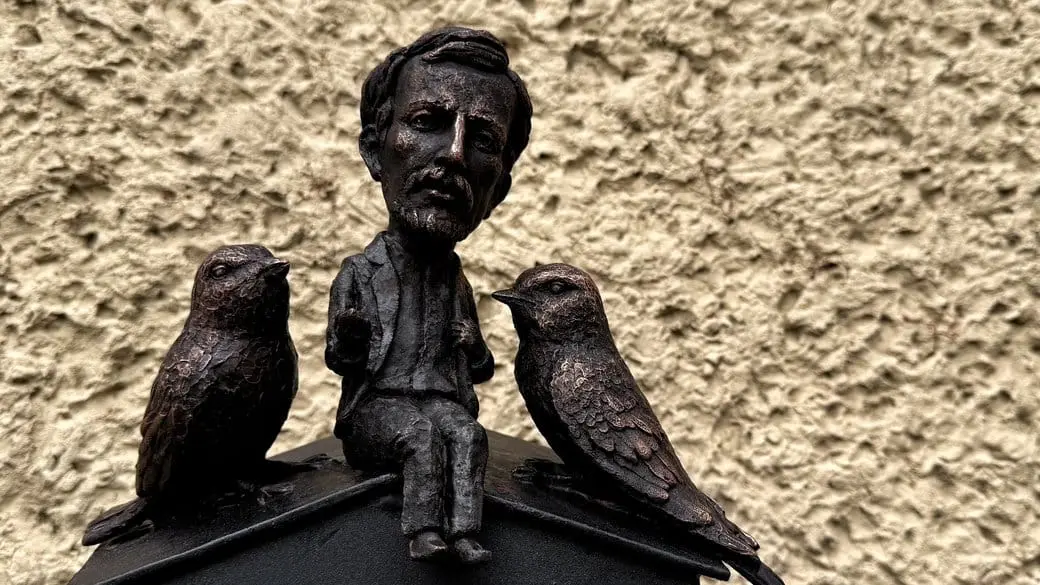
The mini-sculpture to celebrate M.Leontovych and his Shchedryk appeared in Uzhhorod, Ukraine in December 2024. ©Photos by Suspilne
Shchedryk(Ukr. “Щедрик”) by Lviv National Opera, 2022
🎼Listen to Christmas
The first recording of Shchedryk (Ukr. “Щедрик”), 1922
Caroll of the Bells by basketball players (NBA Christmas commercial), 2012
Caroll of the Bells by Pentatonix (a cappella), 2012