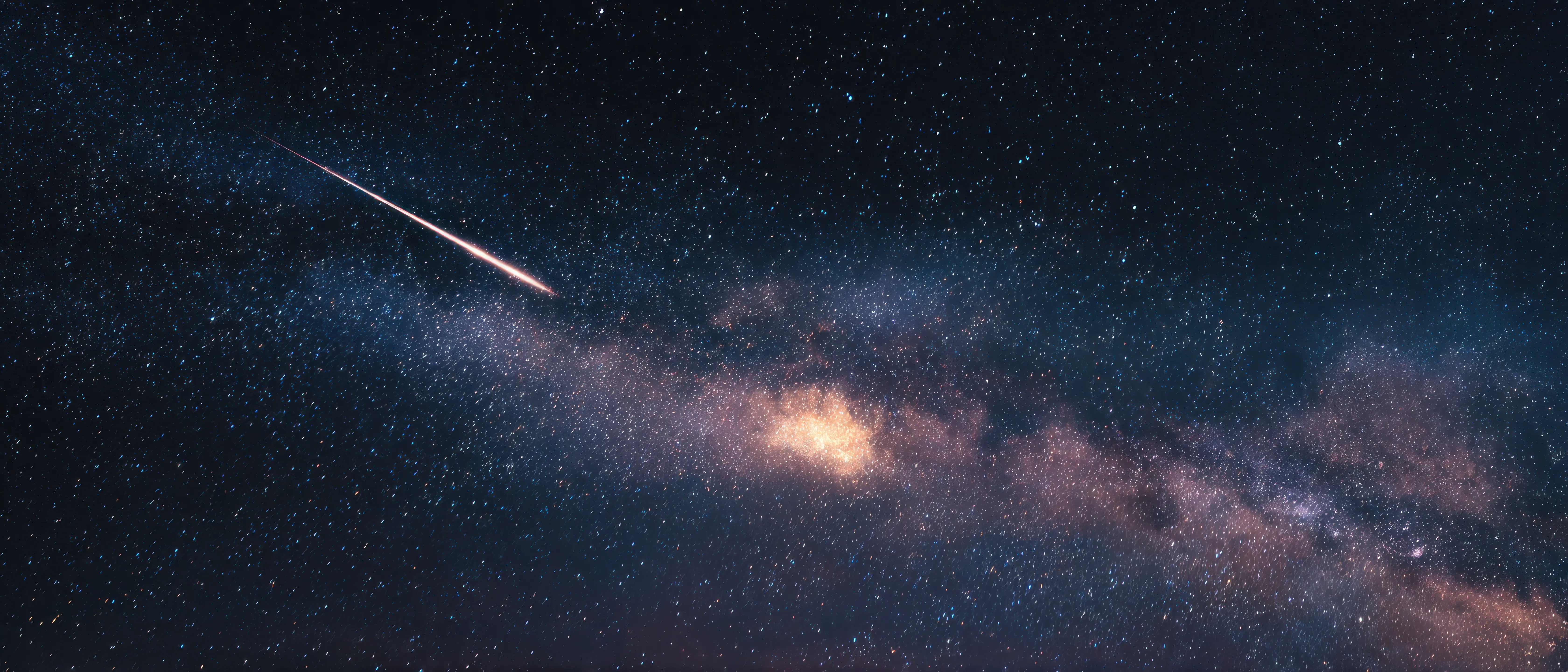
1456, 1531, 1607, 1682, …?
Edmond Halley’s bid was 1758. And he was absolutely right! Even though he never got a confirmation.
But let’s start from the very beginning: to Halley, the task was not that easy at all.
In 1695, when this story began for Halley, he got a list of more than 20 figures, each marking a year when a comet had been seen in the sky. By that time, it was clear that comets lie far beyond the Earth’s atmosphere while other common believes were that those bright flying bodies appeared randomly (almost like an ill omen from gods) and had straight paths as their trajectories. That’s how comets were seen from the Earth.
Less than 10 years before that, Isaac Newton’s Principia Mathematica had been published. The book was of special value to Halley for a few reasons:
- Halley knew there were other scientists trying to solve astronomical problems which Newton had already solved several years earlier.
- It was Halley who pushed Newton to gather his calculations and theories and finally make it a book.
- Halley helped to edit the book and paid for its publication when the Royal Society refused to do so.
Newton was the first to assume that comets did not necessarily travel in straight lines. They could have their own orbits and thus, the notes describing known comet appearances could relate to all different comets. Based on gravity and his other calculations, one and the same comet could pretty much be visible on various occasions. However, Newton did not manage to explain it properly or provide a model of how all those guesses and findings had to work together. Now, in 1695, Halley was there to revisit the question.
Halley was already a prominent scientist who was at his very late 30s at the time. When Newton’s Principia got published, Halley was lucky in the sense that he knew where to look at, what to pay attention to, and how to interpret the knowledge presented by his colleague. Then, the “dirtiest” part was ahead – long, long strings of calculations. And recalculations.
If comets are from beyond the Earth’s atmosphere, then they are at the level of the Solar System.
If so, they may be more similar to planets than we believe now, meaning comets probably have their own orbit.
If so, the orbits must be in some relation to the Sun. They also must be affected by gravity of other planets. Let’s take Jupiter and Saturn as the biggest.
With Newton’s laws, previous detailed observations, and his own scientific intuition, Halley figured out possible orbits of the comets from the list. He, of course, compared the data, and that’s when the largest miracle happened: at least three notes resulted in almost matching orbits. The interval between those three comet appearances was 75-76 years. It just must have been one and the same object! Newton was right but from now on the idea was mathematically proved.
Halley published the results of his work in 1705. He was in his early 50s. While busy with the research on comets, by the moment, he had also conducted three ship voyages for exploration, come back with fresh contour maps showing magnetism in the ocean, been appointed Professor of Geometry at the University of Oxford.
He did not stop on that, and during the following years, Edmond Halley would also calculate the exact distance between the Earth and the Sun (can you?🫣), translate works on geometry by Greek scientists, try to determine the age of Stonehenge, and finally, become Astronomer Royal.
After all these adventures, Halley though left this world with his main guess still being only a guess: to prove that the comets from 1531, 1607 and 1682 were all the same object, they had to wait for another more than 50 years. Naturally, Halley did not survive that long. But he strongly asked to look for the bright ball in the sky in 1758.
Surprisingly, there were no signs of a comet either in the summer or in the autumn, like it had used to be. The large tailed flying star came back on the Christmas Day in 1758 – and stayed visible for those on the Earth for about half a year, longer than ever previously.
💫 Oh, sure. The next appearance of the Halley’s Comet is scheduled for 2061. Lucky you who’ll witness something Halley himself could only believe in! 💫