How was one life changed by three intuition-based decisions?
His most vivid memory from the early childhood was pain and that specific smell of hospitals. He found it equally easy with gangsters and the most prominent artists of the times – as a child he could not always recognise the latter. Whether he had learnt it or had it as an innate skill, he used to trust his intuition when trying to figure out what he wanted from life. Meanwhile, some of the most trusted people would abolish what Astor thought he needed most of all – they just felt like that and that's what saved the future tango revolutioniser.
His father’s gut feeling
Italian by his parents’ origin, Astor was born 400 km from Buenos Aires. Argentina was then one of the top-10 richest countries in the world. And despite this fact, Vicente Piazzolla, Astor's father, was looking for something better. In four years the family emigrated to New York. There they would face the Great Depression, decide to head home to Argentina, and come back to the USA again - for years, Astor would recognise his life in New York as the "normal life."
So, we are in New York with the family of Piazzollas. We can only try to imagine what it felt like for them when on the week between Christmas and New Year, the top celebrity of Argentina and the whole Latin America, best composer and singer of tango Carlos Gardel also came to New York for life.
Por Una Cabeza, one of the most famous tango songs written by Carlos Gardel (lyrics by Alfredo Le Pera) (1935)
...Cradled in Buenos Aires, tango had already reached Europe and North America.
Vicente Piazzolla strongly admired Gardel and transformed his devotion into a wooden carved figure of a gaucho[=EX1] playing a guitar. He then sent his son to deliver the gift.
Already at the entrance to the building, Astor met a man with two bottles of milk who was going to the same apartment but discovered he did not have the key with him. The man was Alberto Castellanos , Gardel’s colleague. Speaking Spanglish[=EX2], they agreed on the 12-year-old boy reaching the window by the fire escape stairs, waking up Gardel and asking him to open the doors.
The first one to wake up was Gardel’s lyricist who didn’t appreciate the approach, while Gardel himself invited the boy to have breakfast together. When he discovered Astor speaking English, he found shopping being way easier with the boy. When Astor told him he could play bandoneon[=EX4] (oh, that bandoneon, his father’s gift Astor first tended to keep in bathroom), Gardel allowed the teenager to play at his private gatherings. In two years, Astor was invited to play a tiny role in a film by Gardel.
What would you do as Astor’s father when discovering that the biggest celebrity you greatly admire is ready to take your son for an international tour? To Astor, it seemed a golden chance to make a career but Vicente Piazzolla said 14 was too young to take that chance. Another youngster joined the touring team, and …none of them survived the airplane crash in the sky above Medellín in Colombia. The only thing which did was that little wooden carved figure of gaucho, a symbol of friendship Gardel had once received in a very unusual way.
His own intuition
By 1937 it became clear that the Depression affected Argentina less than the United States, and the family returned to Mar del Plata, that city 400 km away from Buenos Aires. Astor’s parents bought a new house, his father started a bar and a bicycle store and offered Astor to take bookkeeping as his job. The 16-year-old Astor didn’t want it. Mar de Plata was his birthplace but never felt his home. He had mastered Bach, Mozart, and Schumann in New York, and here, in Argentina, tango was the king. He didn’t belong to this culture, he was not one of the locals.
It changed in about a year and half. During a siesta[=EX3], Astor decided to turn on radio. The tango he then heard hooked him so strongly that he evoked nearly forgotten musical ambitions, remembered the ways he used to reach musicians in New York (apart from the story with Carlos Gardel, Astor discovered one of their neighbours was a classical pianist and they agreed on lessons for which Astor would often bring Italian pasta cooked by his mother), and quickly sent a fan letter to the band members. He received nothing more than a generally nice response, a signed photo, and an upraised motivation. Who knew that about 20 years later, Elvino Vardaro , the violinist after whom the sextet was named, would become part of Astor Piazzolla’s own bands.
But before that, Astor discovered a bandoneon player who once had been a member of the Vardaro's band, Aníbal Troilo , becoming famous with his own orchestra. Astor loved the emotional and innovative style of the Troilo’s band but could only dream about joining them.
Astor moved then to Buenos Aires for job-hunting. He once appeared in a café, tired and with his head full of thoughts about future. Astor was drumming on a table with his fingers when a man in his 20s talked to him. The man was also a former violinist from the Vardaro's band which had once mesmerised Astor through a radio broadcast and, by chance, an active member of the Troilo’s band. Astor knew their whole repertoire and felt it could be worth it to keep in touch with the musician. He was right – when Troilo had to urgently substitute a bandoneonist who fell ill, Astor surprised him with his skills and knowledge and got the job.
His teacher’s insight
The cooperation between Astor Piazzolla and Aníbal Troilo lasted for six years, until the band leader began to fear that Astor’s own ideas and style would make his band less popular among local tango lovers. Astor left the band, created his own orchestra and started composing for regular audiences as well as for films. In a few years, he found himself so immersed in composing and so fed up with traditional tango that he quit the bandoneon and turned to studying classics. A symphonic piece he wrote for the Buenos Aires Philharmonic won him a scholarship for studies in Paris.
After analysing Astor’s compositions, his music teacher had an impression of something being wrong there. She could hear patterns Astor had learnt from famous composers but could not find Astor’s uniqueness. That was, in fact, Piazzolla’s initial aim, to do anything but tango. The teacher, however, made Astor play a piece of tango of his own. She was right, that’s where Piazolla’s authenticity was.
"This is the real Piazzolla! Don’t ever leave him!"
(the teacher's words at hearing Astor's tango)
He didn’t. With all his heart he strived for new motifs, new rules, new approaches, and decided to follow the way. Often he was not understood, he was even beaten for changing traditional repetitive tunes...
Ultimately, Astor Piazzolla’s music was faster in conquering Europe and North America than his birthplace, Argentina. And even when in 1969 his premiere concert was largely criticised and booed in Buenos Aires, more than 200000 copies of the recordings found their devoted fans just in four days.
Libertango by Astor Piazzolla (1974)
Libertango played by 40 Fingers , an Italian guitar quartet, 2018
[=EX1] a skilled horseman, famed for hardiness and lawlessness; a folk symbol of Argentina and Uruguay
[=EX2] a language variety which results from combining Spanish and English
[=EX3] an afternoon nap or rest (from Spanish)
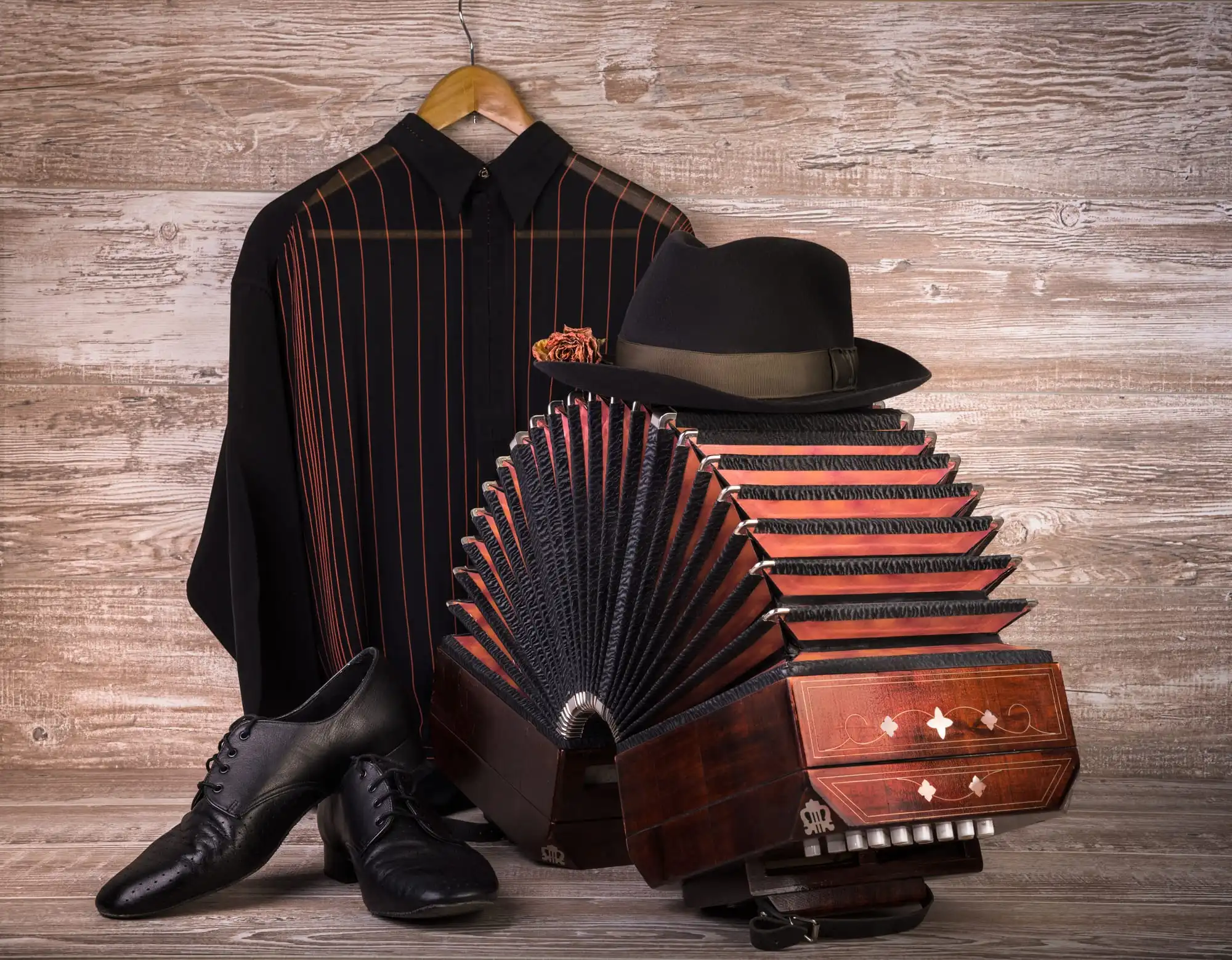
[=EX4] a musical instrument, similar to accordeon, particularly popular in Argentina and Uruguay; is a typical instrument in most tango ensembles. See the instrument on the image associated with this article.