
The frog was dead but its legs moved. What did Alessandro Volta have to do with it?
Is there any electricity in a frog’s body?
If so, what happens to it when the frog has lived its best life, breathed its last, and can only become a part of lunch for some other creatures?
Back in the 18th century, these were kind of things people were trying to understand about the surrounding world. Sometimes, knowledge (or what was thought as knowledge) came from accidental observations rather than from tedious research.
Following the legend, that’s what happened to a Luigi Galvani’s assistant. They were working on some studies which involved frogs’ legs, and the assistant touched the sciatic nerve with a metal scalpel. The frog was dead but its legs moved. Galvani became curious about the effect and was playing with it until he could repeat the process under control. The only explanation he had for the phenomenon was a specific vital force which gives life to a body and, for some reason, reacts to metal instruments after the body’s death.
What did Alessandro Volta have to do with it?
Similarly to Galvani, Volta was an experimental physicist from northern Italy, just seven years younger. Volta became aware of what Galvani had called "animal electricity" and got very doubtful about animals (and particularly frogs) being the key element of the phenomenon.
After a number of experiments, Volta claimed that the thing was the two different metals touching the frogs’ bodies. These two metals would create the electric current of a certain force (depending on exact metals), and the object in between (here: a frog) would indicate the presence of current and conduct it further.
It was Volta who named the phenomenon "galvanism," and it was Galvani who didn’t believe the explanation provided by Volta, published a book on "animal electricity," and relied on his nephew for further investigation.
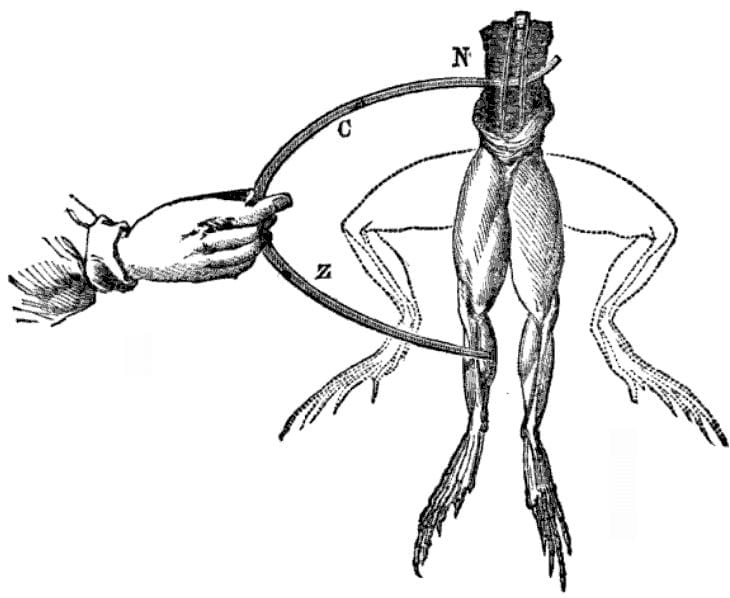
Demonstration of galvanism (or "animal electricity"): electrodes touch a frog, and the legs twitch into the upward position. Image: Wikimedia Commons
Alessandro Volta’s response was humble while rigid. He substituted frogs with paper soaked in salty water and demonstrated the same phenomenon. It took him almost a decade to understand how various combinations of metals work together but the result was certainly worth it: he came up with a so called "voltaic pile" made of copper and zinc, which basically was the first prototype of alkaline batteries we now use daily as a source of power.
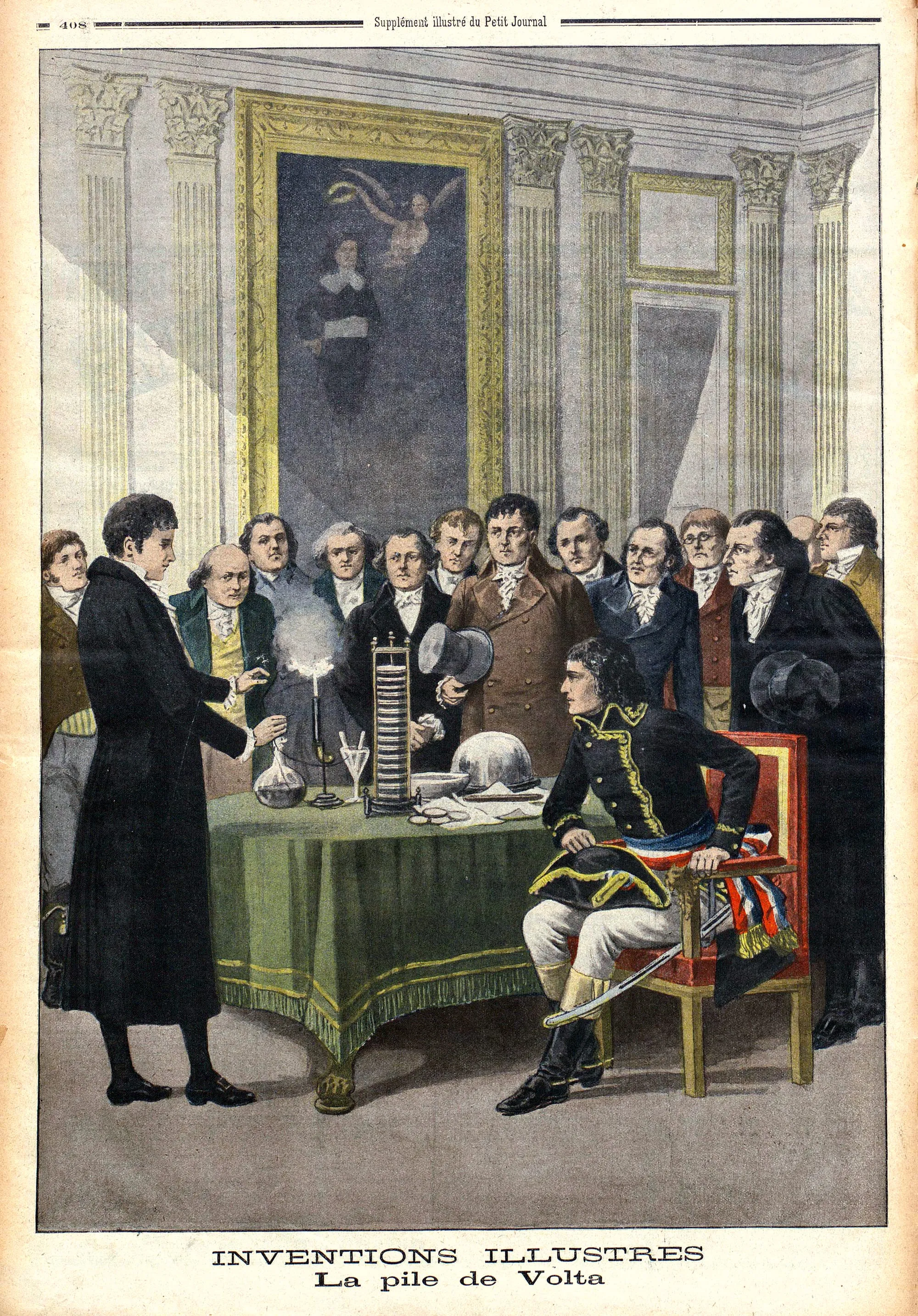
Alessandro Volta demonstrating his pile (battery) to Napoleon in Paris, 1801. From Le Petit Journal (1901).