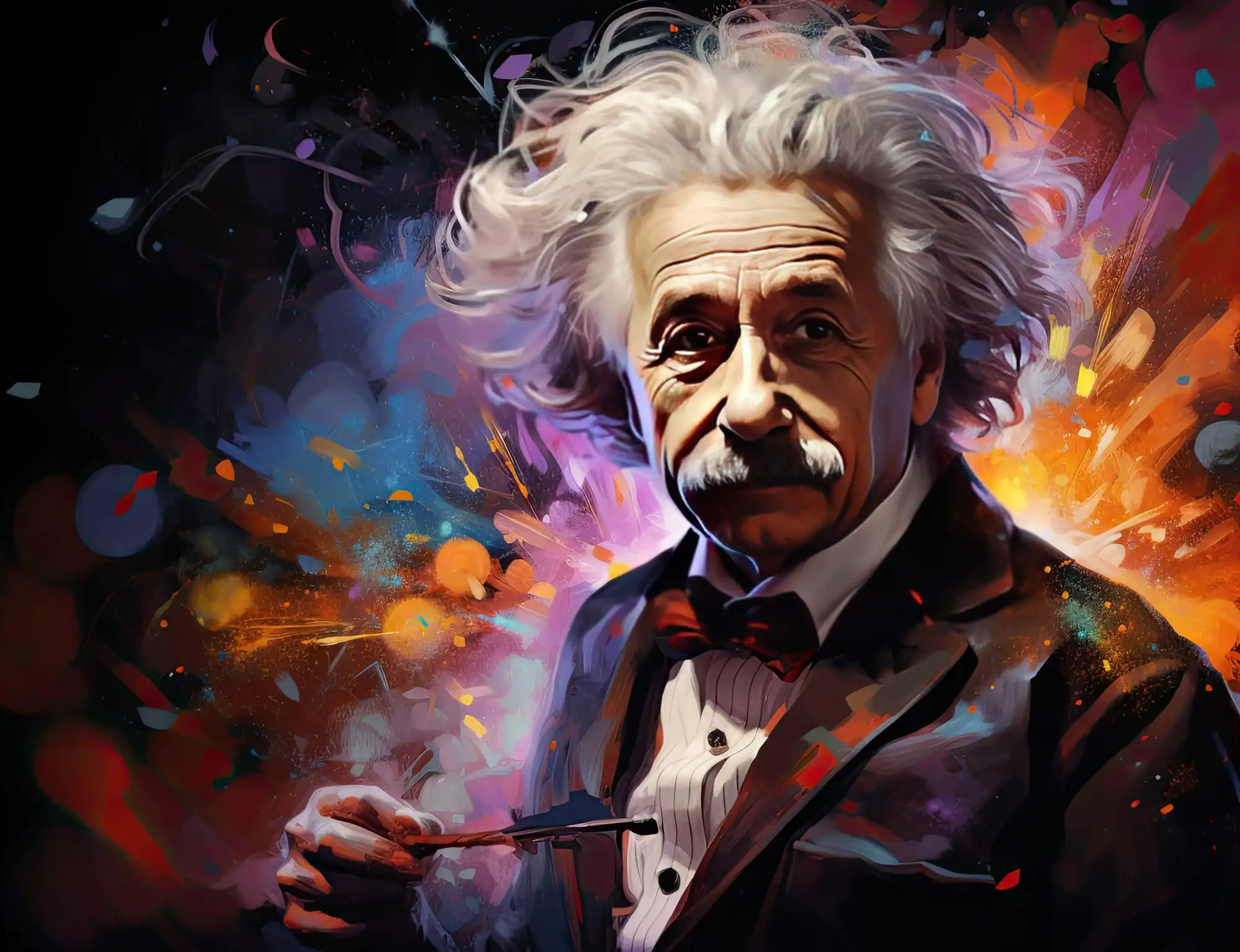
How to choose hobbies wisely?
People commonly acquire hobbies by just starting something out of curiosity – and staying with it if it feels right. Sometimes, though, everything sounds interesting or nothing really clicks, and we get stuck at picking just a single leisure activity. But let’s think about it: there is no real need to stick to one only and you, actually, win with diversification!
Below we check how the recently popular five hobbies rule worked for one of the greatest minds in the history, Albert Einstein.
Before we dive into the exploration, here’s a brief explanation of the concept: To bring more fulfilment to life, you should have five hobbies (and make sure to enjoy them) – one to be in a good physical condition, one to build knowledge, one to stay creative, one to evolve the mindset, and one to make money.
Keep fit
Albert Einstein was not particularly interested in sports, but he is well known for especially enjoying sailing and walking as physical activities. He tried sailinlg for the first time as a teenager in Zurich. For the 50th birthday, his friends presented him a sailing boat which he named Tümmler (Eng., porpoise[=EX1]). Einstein was not a skilled sailor – it was challenging for him to a follow a direction, so he would often rely on wind – but he genuinely loved the process as a possibility to relax, dream, feel easy and fearless like a child. In 1933, when Einstein had already emigrated to the USA, his boat was confiscated and re-sold by Nazis.
Walking became something in-between a hobby and a habit for Einstein. The scientist would make at least two daily walks as a way to stimulate his thinking and problem-solving skills.
Build knowledge
Albert Einstein was an avid reader. Reading, of course, was part of his job but even before that, Einstein had spent many hours with a book in his hands as a student getting classical education. He was a curious student and thus trained the skill of being a critical reader. Later, the physicist even started the Olympia Academy (a small club with only three members, including himself) to discuss scientific books and literary works, philosophy, and physics.
Somebody who only reads newspapers and at best books of contemporary authors looks to me like an extremely near-sighted person who scorns eyeglasses. He is completely dependent on the prejudices and fashions of his times, since he never gets to see or hear anything else.
Albert Einstein
Einstein admired works of Goethe, Cervantes, Spinoza... He would bequeath his personal library and archives to the Hebrew University of Jerusalem where he was one of the founders, and the library included, among many others, works by Euclid, Kant, Schopenhauer, Heine. While an active scientist, Einstein certainly needed a base to ground his theories on, and books provided knowledge he could rely on.
Stay creative
This was perhaps Albert Einstein’s favourite hobby, apart from thinking. Similarly to many children nowadays, he was exposed to the first music lesson at the age of six – his mother was a keen pianist, and she later taught Albert to play piano and violin. The boy wasn’t enthusiastic about the experience until six or seven years after the first class, when he discovered symphonies by Mozart. From then on and for the rest of his life, Einstein would play violin and, first of all, Mozart or Bach when seeking solutions for a mathematical or physical problem. In addition, Einstein was a passionate improvisor. While being a good tool to train self-expression, it also allowed Einstein to keep working on science "in the background" and produce new ideas during such playing sessions.
Einstein owned several "Linas" (the way he called his violins) – the one specifically crafted for the scientist was sold for $516500 at an auction in New York. He occasionally played in duet with Max Planck, another German theoretical physicist, and Queen Elisabeth of Belgium. Einstein used music both to get to know more people and to understand the world. He applied musical terms to physics and, ultimately, viewed career of a musician as a real alternative for himself in case he had not gone seriously into physics.
Evolve your mindset
Some of the hobbies frequently recommended in this category include doing puzzles, crosswords, or playing logical games. Given that Albert Einstein could play chess (though would not always admit it openly), we can say he had this kind of hobby, too. But let’s be honest, Einstein was not a determined chess player and didn’t really like the game. The reason? Its moral side. It looked to him like one player is supposed to deceive another one and make it all a competition. The physicist would only play chess to relax and have fun, and on these conditions, he would even play with children.
And let’s not forget the whole context: Einstein was answering questions about how the Universe is built – isn’t that evolving enough for a human mind?
Two things are infinite: the universe and human stupidity; and I'm not sure about the universe.
Albert Einstein
Make money
At first glance, it doesn’t look like Albert Einstein had any hobby which he really used to earn his living. But wait, his most-liked activity was thinking as such, and answering questions in physics by thinking was the approach that differentiated Einstein from other scholars in the field – they tended to measure and calculate more than to conduct thought experiments.
Together with that, Einstein was a paid lecturer and a researcher at universities, an author of books, and one of the winners of top awards like Copley Medal and Nobel Prize, all of which would be accompanied by a financial gift or compensation. Hence, Albert Einstein literally did make money from his outstanding way of thinking while his other hobbies just made brainstorming less boring and more effective for him!
More about Einstein's world
Inside Einstein's Love Affair with Lina – an article by National Geographic about Einstein's involvement in music
The Complete Idiot's Guide to Understanding Einstein – an easy-to-read book dedicated to Einstein's biography, ideas and worldview by Gary Moring (full version available at archive.org)
[=EX1] small dolphin-like acquatic mammal